
































by Éric Sabourin
At first glance, one does not fully grasp the energy expended in transcending technical virtuosity to serve, purely, the primal dramatic expressiveness of each of the heroic title roles: it remains the invisible battle horse of John Cranko’s 1962 choreographic version of Romeo and Juliet, danced to the music of Sergei Prokofiev.
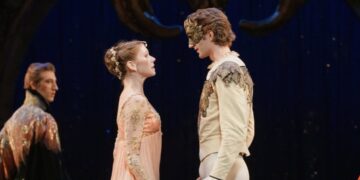
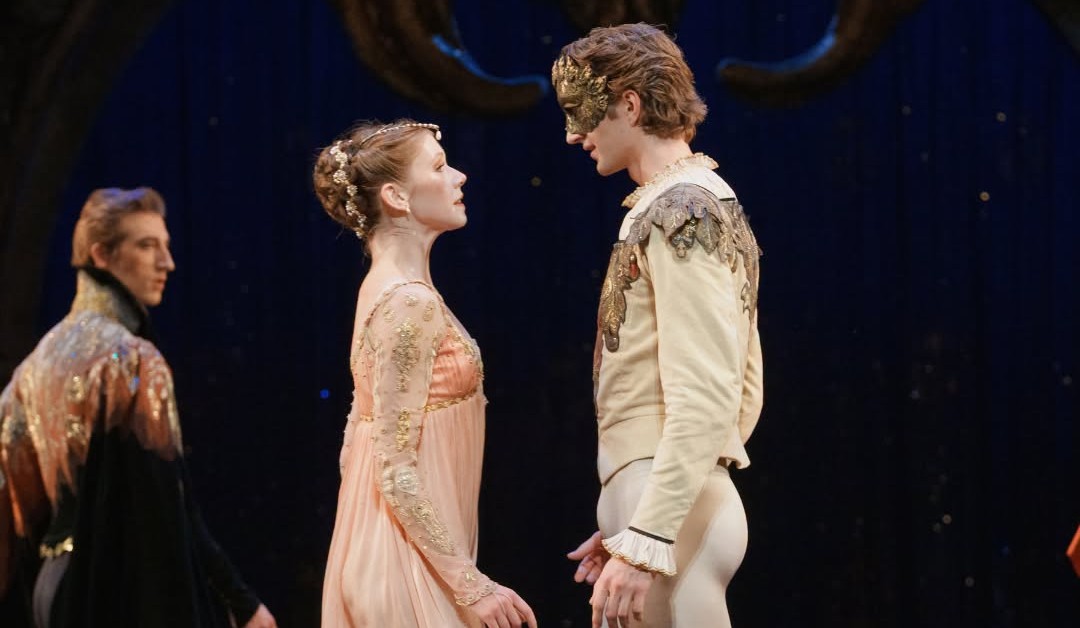
The collective feat of the phenomenal National Ballet of Canada, celebrating 75 years of vocation with this work on Saturday evening, October 31, found its most absolute glory in the twin hearts, living and dying, of Romeo (Oliver Yonick) and Juliet (Isabella Kinch).
Radiant Feats
From the first act, a Pas de trois brings together Romeo, Mercutio (Donald Thom) and Benvolio (the sensational and impeccable Tom Cape), whirling through combinations of grands jetés that demand the purest synchronization of the trio. This number keeps us breathless at the brilliance of what seems to be frivolous, cheerful banter, a prelude to the brotherly revels of these adolescents: I would even say their exuberance is that of puberty, yet never out of breath… and this effervescent number pushes to the very limits of human muscular endurance.
In this first act, which feasts the spectator’s eye with the most beautiful costumes imaginable in group scenes of jubilant, multicoloured crowds, comes the greatest moment of physical prowess for the supremely elegant Hercules that Romeo then becomes: highly acrobatic overhead lifts that appear disarmingly natural, lifts of his beloved through which principal dancer Oliver Yonick displays his prodigious strength, sending into aerial suspension the magnificent, ecstatic performer flawlessly embodied by Isabella Kinch.
Stellar Arabesques
In the firmament of the heavens, on the sensual balcony of this pas de deux, Isabella Kinch traces, in her rapturous arabesques, lines of unforgettable grace. This is great art brought to its most absolute perfection, undoubtedly the great technical moment of this virginal romantic ride.
Mercutio’s Variations
As the virtuoso numbers follow one another in Act 2, dancer Donald Thom, as Mercutio, must feign the emotion of jest in the midst of a popular festival, with movements of surgical precision, notably incessant pirouettes and assortments of petite batterie to rhythmic music.
Yet he dies at the heart of this game of prettiness and general carefree abandon, managing to separate the emotion from his own tragic end. What a tour de force!
Although I do not know whether he also had to perform at the matinee on the same opening day, twice in a row on the same day, during the free performance offered to the general public in the same venue, his evening performance deserves sincere praise.
The Bedroom, Act 3
The Aubade and the Farewell of the final act will have glorified Romeo’s skill as Juliet brushes against him in fine, feather-light perpendicular glides along his virile body, demanding of the young man and his adolescent partner weight transfers that are anatomically most uncomfortable, without any of it showing, of course, since the dancers must convince a spellbound audience to see only the surge of romantic feeling.
The Crypt: Juliet’s Death
The simulation of the dead weight of the despairing heroine, Isabella Kinch’s total muscular release as an utterly lifeless body: never had I seen such realism in performance, as handsome Romeo, embodied from beginning to end by the extraordinary Oliver Yonick, lifts her in heartbreak, with fitting grief and understood complicity. What an unforgettable couple, worthy of entering the annals of dance!
A final word to salute the direction of the excellent orchestra, its woodwinds, brass and strings, without forgetting to praise the beautiful, clever progression of the lighting.
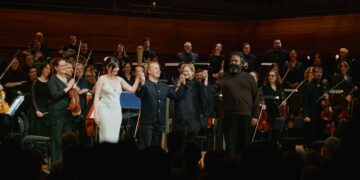
Well-deserved waves of applause rained down at the final curtain of the Four Seasons Centre for the Performing Arts, in the radiant and splendid city of Toronto, joyfully celebrating this anniversary of sublime achievement.